Forex Position Sizing: How to Risk 1% Per Trade Correctly
Calculate the right lot size for any forex pair, gold or index from your account risk and stop loss, with worked examples and common sizing mistakes.
Position sizing is the least exciting part of trading and the one that decides whether you're still trading next year. The idea is simple: choose your risk first, place your stop where the chart says, and let the lot size follow. Not the other way round.
The position sizing formula
Where:
- Risk amount = account balance × risk % (for example, $10,000 × 1% = $100)
- Stop distance = distance from entry to stop loss, in pips
- Pip value per lot = how much one pip is worth for 1.00 lot of that symbol, in your account currency
Worked examples
EURUSD (USD account)
Balance $10,000, risk 1% = $100. Stop loss 25 pips. Pip value for 1 lot of EURUSD = $10.
If the stop is hit, you lose 25 × $4 = $100. Exactly 1%.
USDJPY (USD account)
For pairs where USD is the base currency, pip value depends on the price. One pip on 1 lot of USDJPY is ¥1,000; at 150.00 that's about $6.67.
Gold (XAUUSD)
On most brokers 1 lot of gold is 100 ounces, so a $1.00 move is worth $100 per lot. With a stop $8.00 away:
Contract sizes for gold, indices and crypto differ between brokers. Always check the symbol specification in MetaTrader (right-click the symbol in Market Watch › Specification).
How much should you risk per trade?
| Risk per trade | 10 losses in a row | Typical use |
|---|---|---|
| 0.25% | −2.5% | Prop challenges near the limit, new strategies |
| 0.5% | −4.9% | Conservative, prop firm accounts |
| 1% | −9.6% | Common default for discretionary traders |
| 2% | −18.3% | Aggressive |
| 5% | −40.1% | Gambling |
Your journal tells you your real longest losing streak. Multiply it by your risk and ask whether you could keep trading normally after that drawdown. If not, lower the risk. See maximum drawdown.
Common position sizing mistakes
Sizing by feel
"0.5 lots feels right" means your risk changes with every stop distance. A 10-pip stop and a 50-pip stop at the same lot size are a fivefold difference in risk.
Forgetting costs
Spread and commission are part of what you lose when the stop is hit. On tight stops they matter: a 1-pip spread on a 10-pip stop is 10% extra risk.
Moving the stop to fit the lot size
The stop belongs where your trade idea is invalid. If the correct stop makes the position too small to be "worth it", skip the trade.
Increasing size after losses
Doubling up to recover is the fastest route to a blown account. Your journal can detect it: a position far larger than your normal size, opened shortly after a loss.
Correlated risk
Three long positions on EURUSD, GBPUSD and AUDUSD at 1% each is closer to one 3% bet against the dollar.
Let software do the maths
Calculating lot size by hand under time pressure is where errors creep in. Two good options:
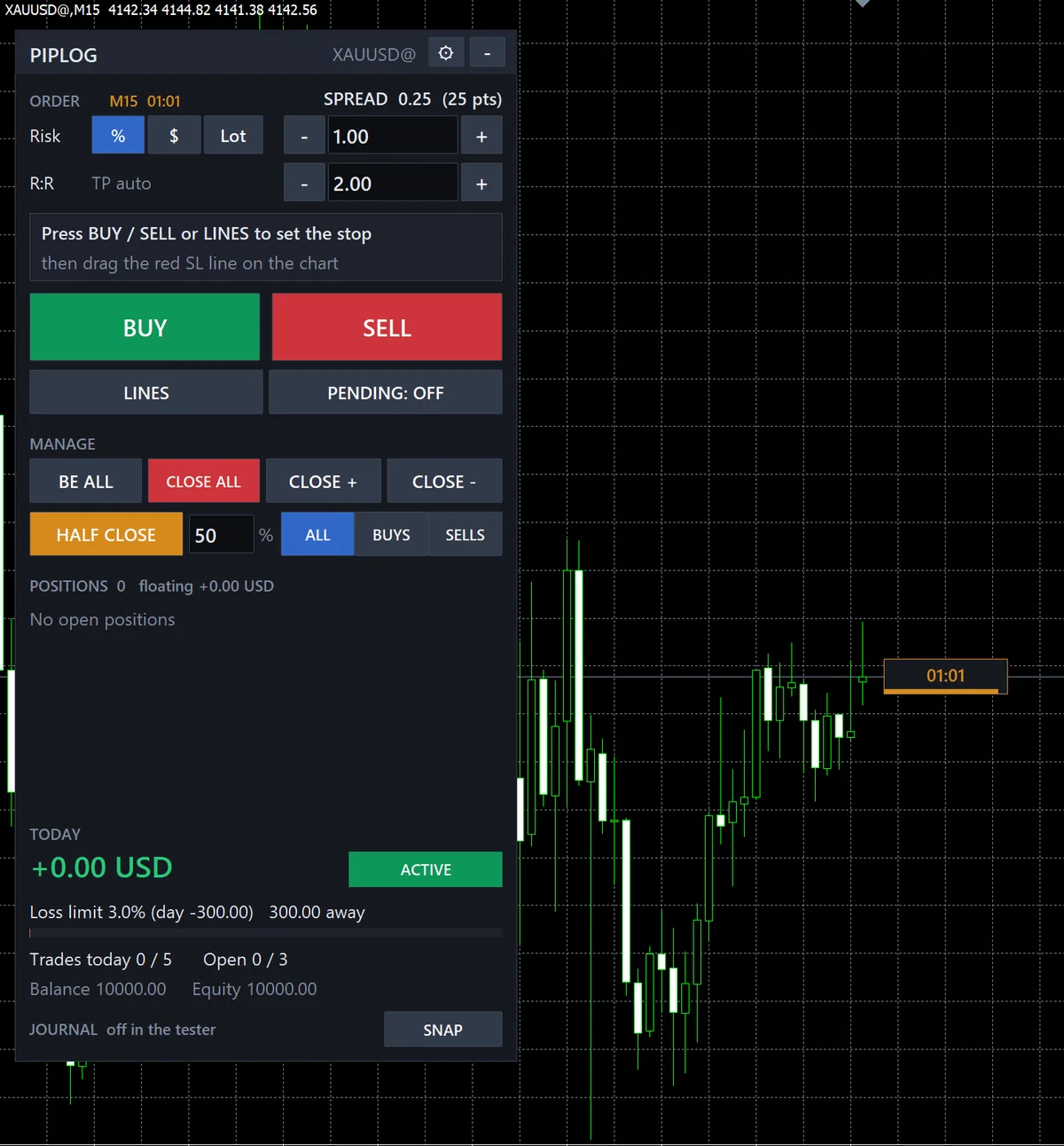
- A trade manager EA. The PipLog EA sizes every panel order from your risk (percent, money or fixed lot) and your stop, can include spread and commission, and places the take profit at your chosen R:R.
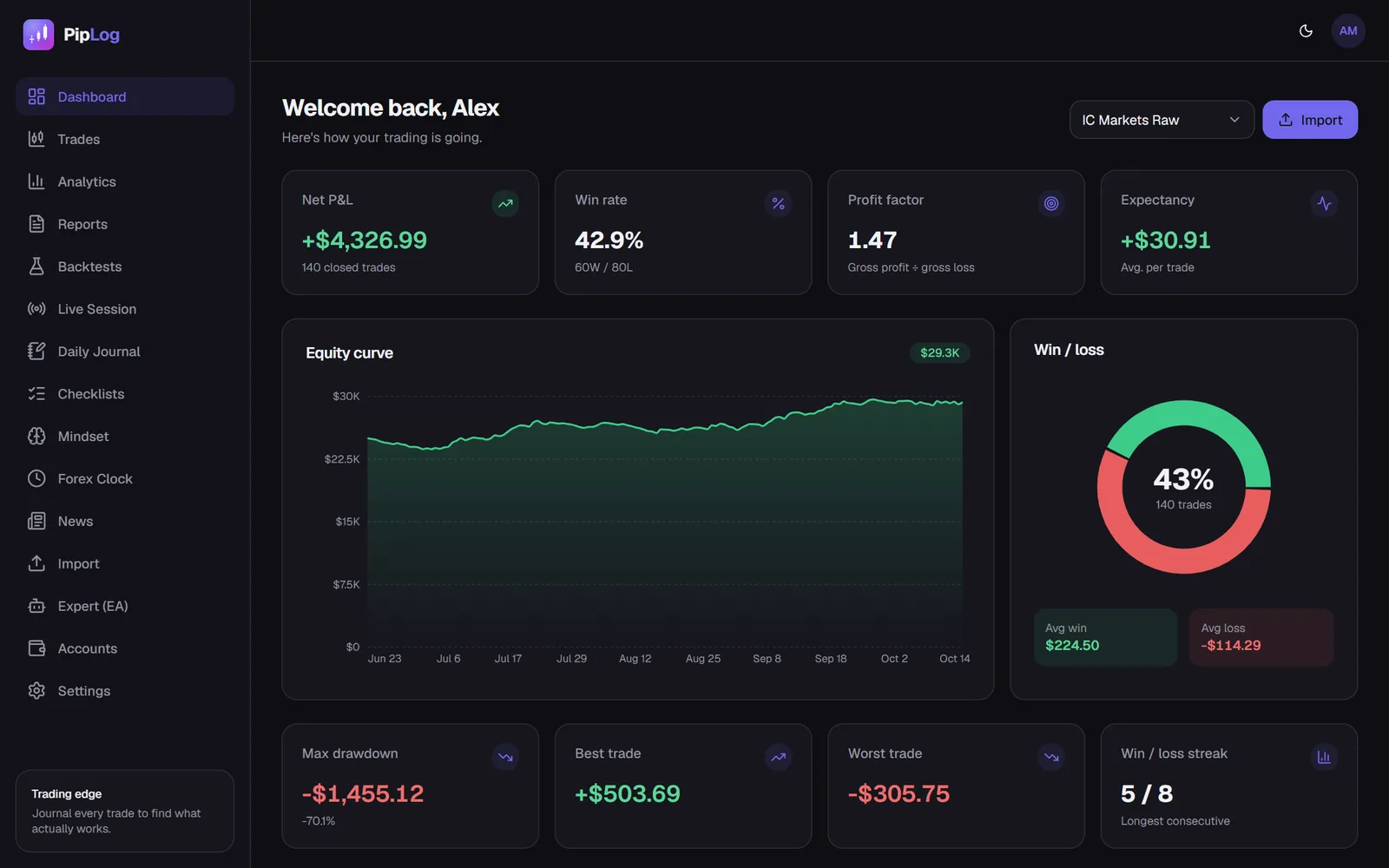
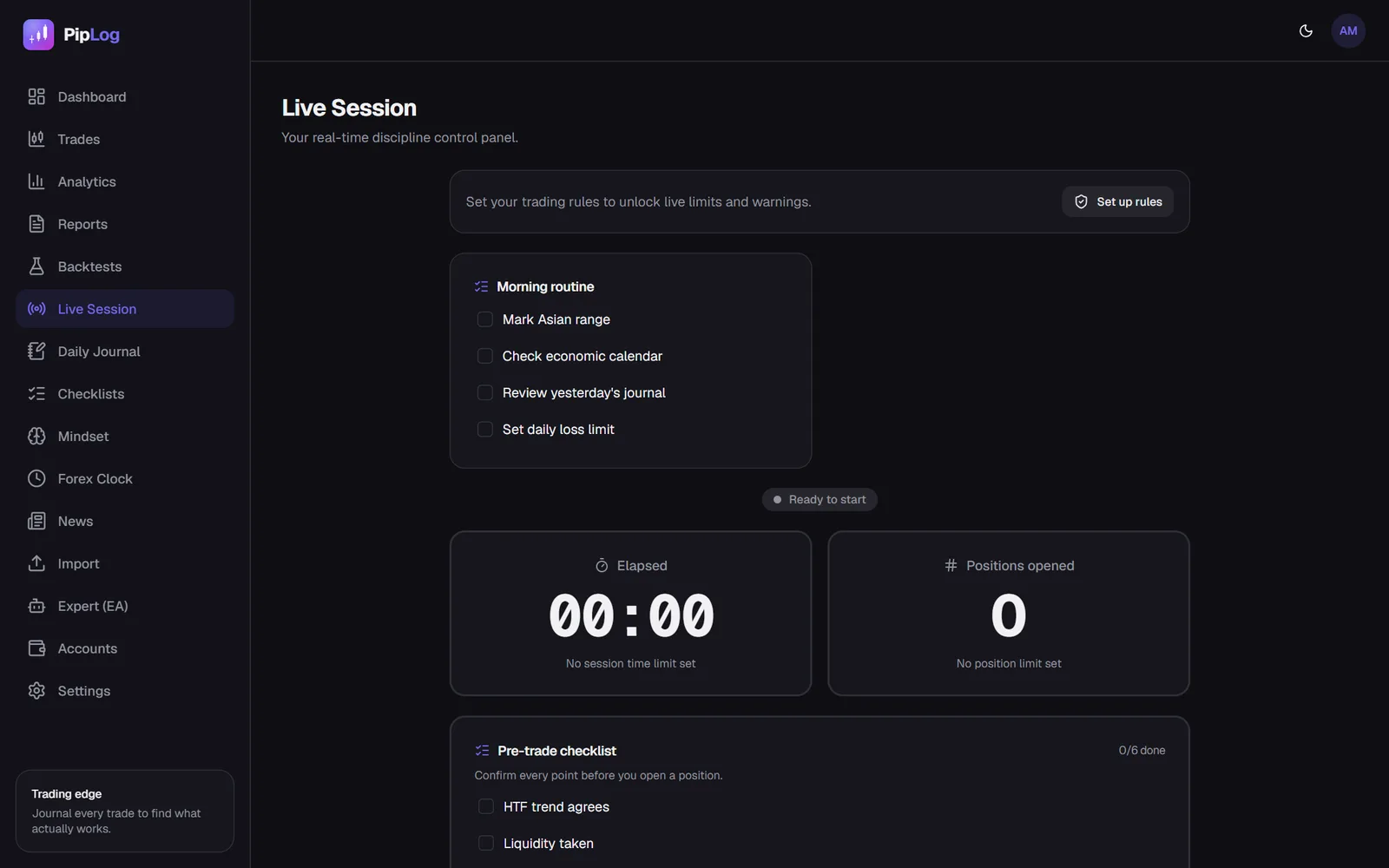
- Rules in your journal. Set a maximum risk per trade and per day, and get warned when you exceed them.
Check your sizing in your journal
Once your trades include the initial stop loss, your journal can tell you the risk you actually took on each trade. Look for:
- Trades risking much more than your target percentage
- Losses larger than −1R (stops moved or skipped)
- Size jumps after losing trades
Journal your MT4 & MT5 trades automatically
Import a statement or sync live with the PipLog EA. Win rate, profit factor, expectancy and drawdown are calculated for you.
Start your journalSummary
Risk a fixed percentage, place the stop where the trade is wrong, and derive the lot size from both. Round down, include costs, and let a tool do the arithmetic so you never size by feel again.