Forex Trading Sessions: Market Hours, Overlaps and the Best Times to Trade
Sydney, Tokyo, London and New York session times in UTC, the overlaps that bring the most volume, and how to find your best trading hours in your journal.
The forex market is open 24 hours a day, five days a week, but it isn't equally active all day. Volume, volatility and spreads change dramatically as the major financial centres open and close. Knowing the sessions helps you trade when your strategy works and stay out when it doesn't.
The four major sessions
Approximate times in UTC. Exact hours shift by an hour with daylight saving time in Europe, the US and Australia.
| Session | Approx. hours (UTC) | Most active pairs |
|---|---|---|
| Sydney | 22:00 – 07:00 | AUD, NZD pairs |
| Tokyo | 00:00 – 09:00 | JPY pairs, AUD, NZD |
| London | 07:00 – 16:00 | EUR, GBP, CHF pairs, gold |
| New York | 12:00 – 21:00 | USD pairs, CAD, gold, US indices |
Session characteristics
Sydney and Tokyo (Asian session)
Usually the quietest period for major pairs. Ranges are tighter, which suits range strategies. The Asian session high and low often become important levels for the London open.
London
The largest trading centre by volume. Volatility rises sharply at the open, and many trends of the day begin in the first two hours. London breakout strategies trade the break of the Asian range.
New York
US economic data is usually released at 8:30 a.m. New York time, so the first hours of the session are dominated by news. Liquidity is high until London closes, then gradually drops.
The overlaps
London – New York overlap
Roughly 12:00 to 16:00 UTC. The most liquid period of the day, with the tightest spreads and the largest moves on EUR, GBP and USD pairs. Many intraday traders focus only on this window.
Tokyo – London overlap
A short overlap around 07:00 to 09:00 UTC. Useful for EURJPY and GBPJPY.
When not to trade
- Around high-impact news unless news trading is your strategy. Spreads widen and stops slip.
- Late Friday, as liquidity thins ahead of the weekend.
- Bank holidays in a currency's home market, when volume drops.
- The rollover hour around 21:00 to 22:00 UTC, when spreads often widen sharply.
Find your own best hours
General session advice is a starting point. Your journal tells you what works for you:
- Break your results down by hour of entry, or by session.
- Compare win rate, average R and net P&L for each.
- Do the same by weekday.
Many traders discover that nearly all their profit comes from one or two hours, and that trades outside those hours are break-even at best. Trading less, only in your best window, often improves results immediately.
PipLog's mindset view also flags off-hours trades: trades opened at hours you rarely trade. They are often impulse trades, and worth reviewing separately. See revenge trading.
Tools: forex clock and news calendar
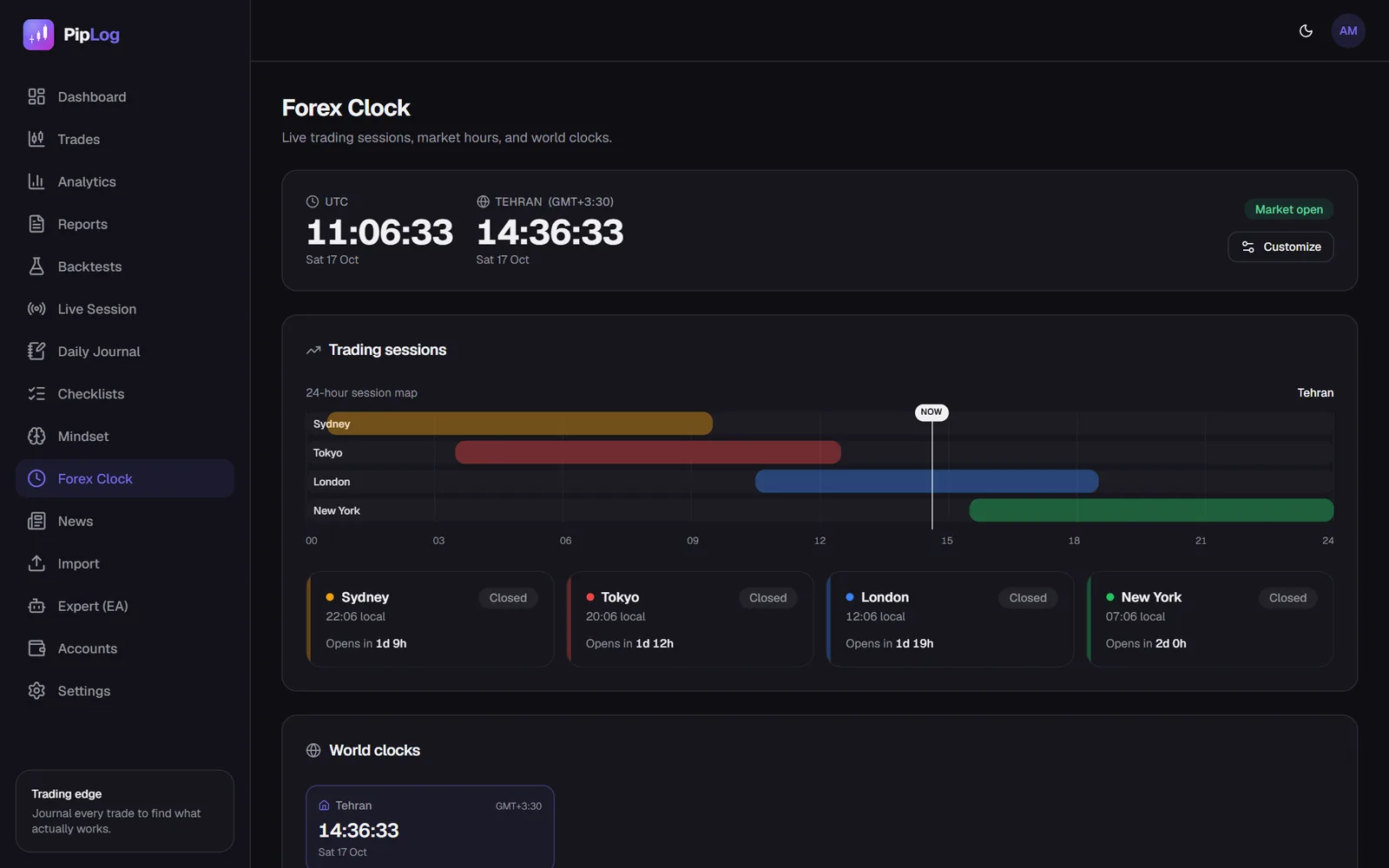
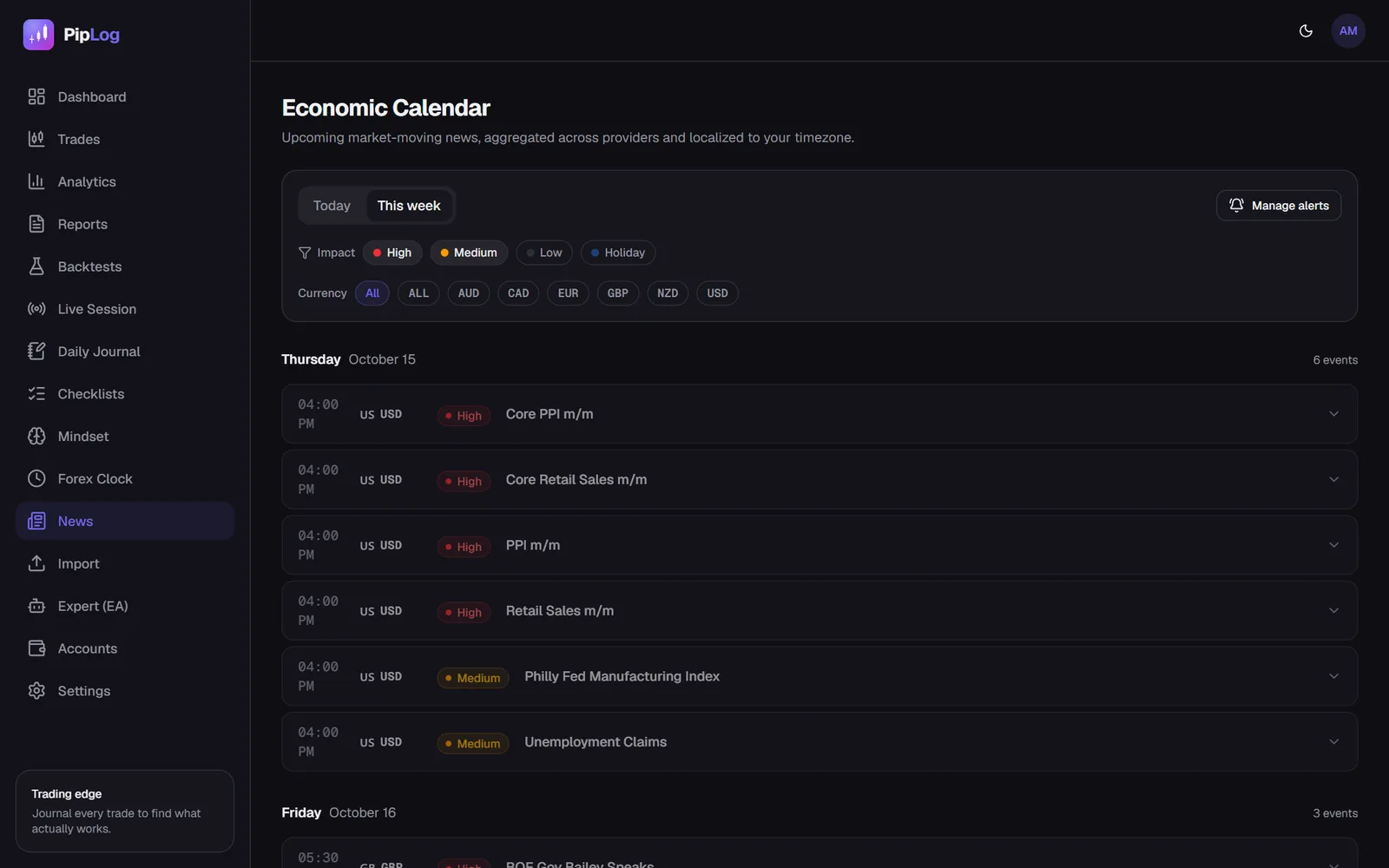
PipLog includes a forex clock that shows which sessions are open right now, in your own time zone, and when the next one opens, and an economic calendar with alerts for high-impact events in the currencies you trade.
Journal your MT4 & MT5 trades automatically
Import a statement or sync live with the PipLog EA. Win rate, profit factor, expectancy and drawdown are calculated for you.
Start your journalKey takeaways
- Sydney, Tokyo, London and New York each have their own character; overlaps bring the most volume.
- The London – New York overlap is the most liquid window for major pairs.
- Avoid high-impact news, late Friday, holidays and rollover unless that's your strategy.
- Use your journal to find your best hours and weekdays, then trade only those.