How to Build a Pre-Trade Checklist You'll Actually Follow
A pre-trade checklist filters out impulsive trades before they happen. How to write one, example checklists for forex traders, and how to enforce it.
Pilots use checklists not because they don't know how to fly, but because under pressure even experts skip steps. Trading is the same. You know your rules. A checklist makes sure you apply them on the trade you're most excited about.
Why checklists work for traders
A pre-trade checklist adds a short, deliberate pause between "I want this trade" and "order sent". In that pause, impulsive trades tend to fall apart:
- FOMO entries fail the "entry confirmation" item
- Revenge trades fail the "within daily limits" item
- Oversized trades fail the "risk at most 1%" item
It also produces data. If every trade records whether the checklist passed, you can compare checklist trades with the rest, and that comparison usually makes the case for itself.
Rules for a good checklist
- Short. Five to eight items. A 20-item checklist gets skipped.
- Binary. Each item is a clear yes or no. "Market looks good" is not an item.
- Specific to your strategy. Copying someone else's checklist means checking someone else's edge.
- Includes risk and state. Not only the setup, but also size, limits and how you feel.
- Reviewed monthly. Remove items that never fail; add items for mistakes that keep recurring.
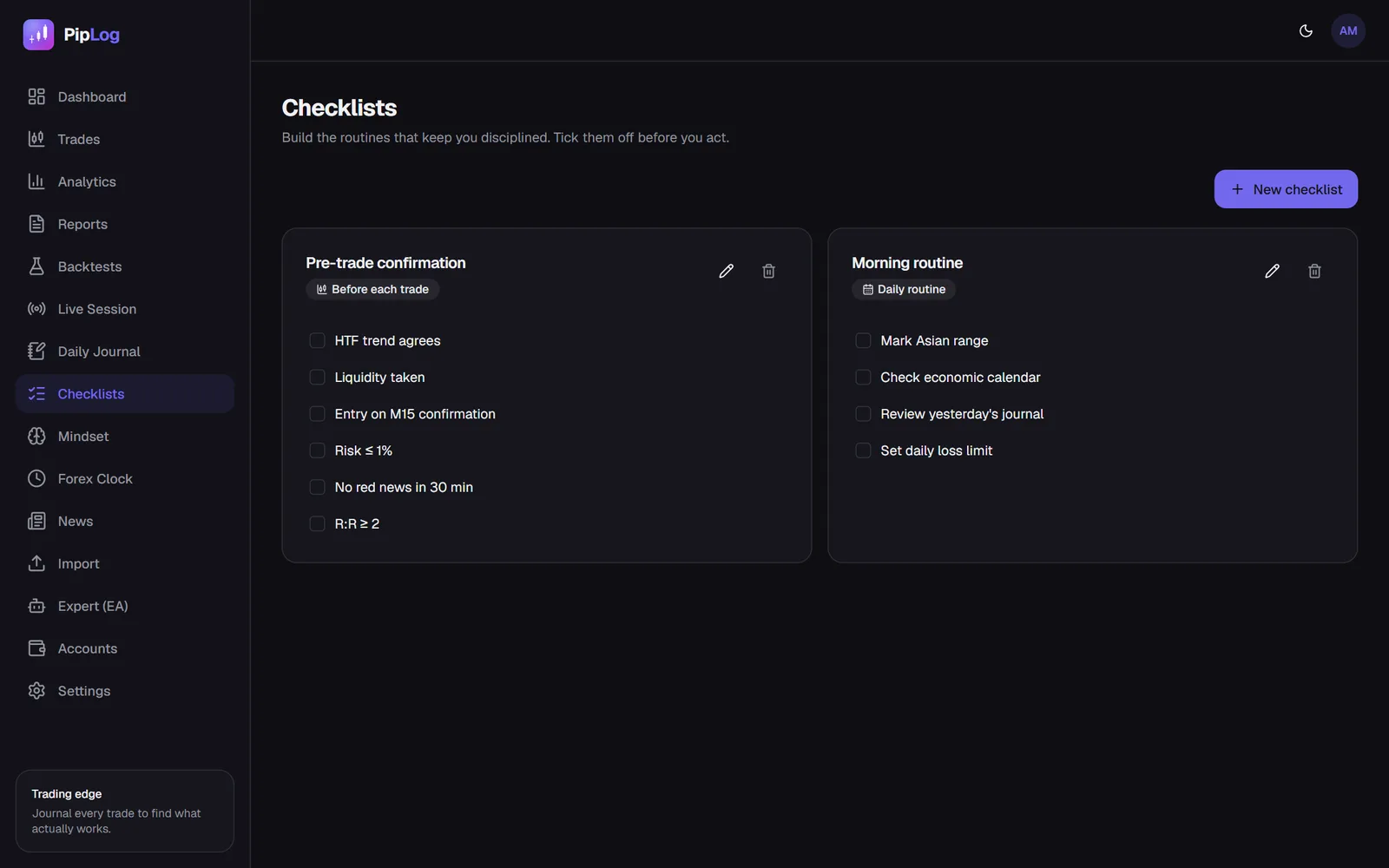
Example: trend pullback checklist
- Higher-timeframe trend agrees with the trade direction
- Price has pulled back into the area of value (e.g. previous structure or moving average)
- Entry confirmation on the lower timeframe (e.g. engulfing or break of structure)
- Stop loss beyond the invalidation point
- Risk at most 1% of the account
- Reward-to-risk at least 2:1 to the next obstacle
- No high-impact news within 30 minutes
- Within today's trade and loss limits
Example: daily routine checklist
Not every checklist is per trade. A daily one sets up the session:
- Check the economic calendar for high-impact events
- Mark key levels and the Asian session range
- Review yesterday's journal entry and lesson
- Set today's maximum loss and maximum number of trades
- Pre-session check-in: mood and energy
Make it hard to skip
A checklist on a sticky note works until the day it matters most. Ways to make it stick:
Tie it to your position counter
In PipLog, trade checklists gate the live session's position counter: a position only counts once its checklist is ticked off. The friction is small, but it's enough to interrupt an impulse.
Pair it with hard limits
Some checklist items are better enforced by software. A daily loss limit or a maximum trades per day in the PipLog EA can't be talked out of.
Record the outcome
Tag trades that were taken without passing the checklist. Your weekly review then shows exactly what skipping it costs.
Building your first checklist from your journal
The best checklist items come from your own mistakes. Open your journal and look at your worst 20 trades:
- What did they have in common? (No confirmation, counter-trend, news, late in the session...)
- Turn each common factor into a yes/no item that would have filtered it.
- Check: would the item have blocked your best trades too? If so, rewrite it.
This takes an hour and produces a checklist built around your real weaknesses, not generic advice.
When the checklist says no
The hardest part is respecting a "no" on a trade that looks perfect. Two things help:
- Remember the sample. A single missed winner costs one trade. Skipping the checklist as a habit costs your edge.
- Journal the missed trade. Note setups you skipped and what happened. If a "no" consistently misses good trades, adjust the checklist on the weekend, not in the moment.
Journal your MT4 & MT5 trades automatically
Import a statement or sync live with the PipLog EA. Win rate, profit factor, expectancy and drawdown are calculated for you.
Start your journalKey takeaways
- Keep it short, binary and specific to your strategy.
- Include risk limits and your mental state, not only the setup.
- Build items from your own worst trades.
- Enforce what you can with software, and measure what skipping it costs.