How to Keep a Trading Journal: A Step-by-Step Guide for Forex Traders
What to record, when to review it and how to turn a trading journal into better decisions. A practical guide for MT4 and MT5 traders.
Almost every consistently profitable trader keeps some form of trading journal. The surprise is that most traders who start a journal give up within a few weeks. They log a handful of trades, the spreadsheet gets messy, and the habit quietly dies.
This guide shows you how to keep a trading journal that survives past the first month: what to record, how to make data entry nearly automatic, and how to review it so it actually changes the way you trade.
Why a trading journal works
Your memory of your trading is biased. You remember the big winner on gold and forget the five small, impulsive losses on EURUSD that paid for it. A journal replaces that memory with evidence.
A good journal answers three questions:
- Do I have an edge? Win rate, profit factor and expectancy tell you whether your strategy makes money over a meaningful sample.
- Where does the edge come from? Breaking results down by symbol, session, weekday and setup shows which trades carry your account and which ones drain it.
- What is costing me money? Notes, emotions and rule-break flags reveal the behavioural leaks: revenge trades, oversizing, trading tired.
Step 1: Decide what to record
Split every journal entry into two parts: the facts the platform already knows, and the context only you know.
The broker facts
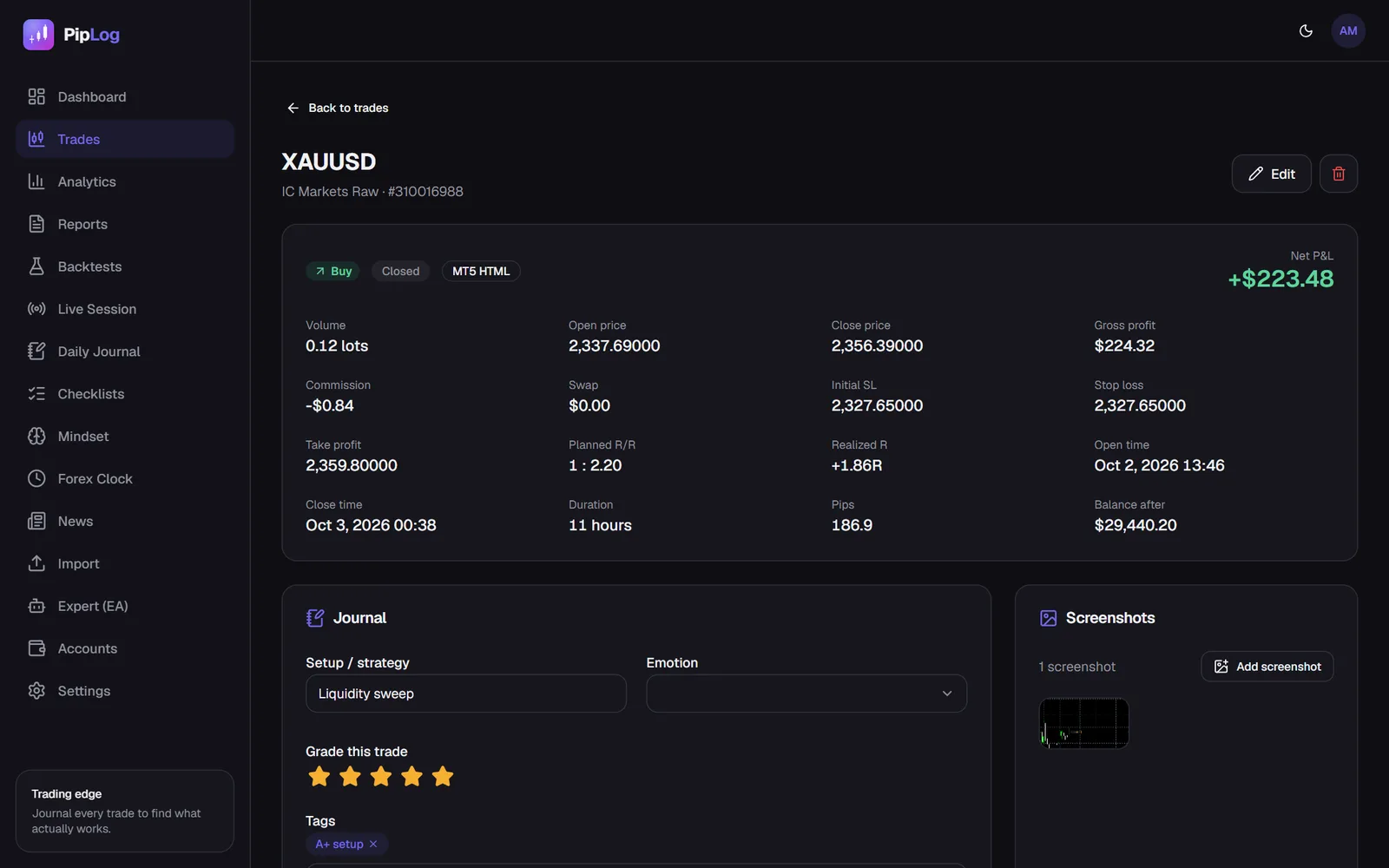
These come straight from MetaTrader, so you should never type them by hand:
- Symbol, direction (buy or sell) and volume in lots
- Open and close time, open and close price
- Stop loss and take profit, including the initial stop loss
- Profit, commission and swap
The initial stop loss matters more than people think. It defines your risk on the trade, and without it you cannot measure results in R-multiples (see R-multiples explained).
The context
This is the part that turns a trade log into a journal:
- Setup — the named pattern or strategy you traded, e.g. "London breakout" or "trend pullback"
- Reason for entry — one or two sentences, written as if explaining it to another trader
- Emotion — how you felt before and during the trade
- Rating — a 1 to 5 grade for how well you executed the plan, not for the outcome
- Mistakes — anything you did that your rules don't allow
- Screenshot — the chart at entry and at exit
Step 2: Automate the boring part
The number one reason journals die is manual data entry. If you have to copy ten fields from MetaTrader for every trade, you will stop doing it.
There are two ways to automate the broker facts:
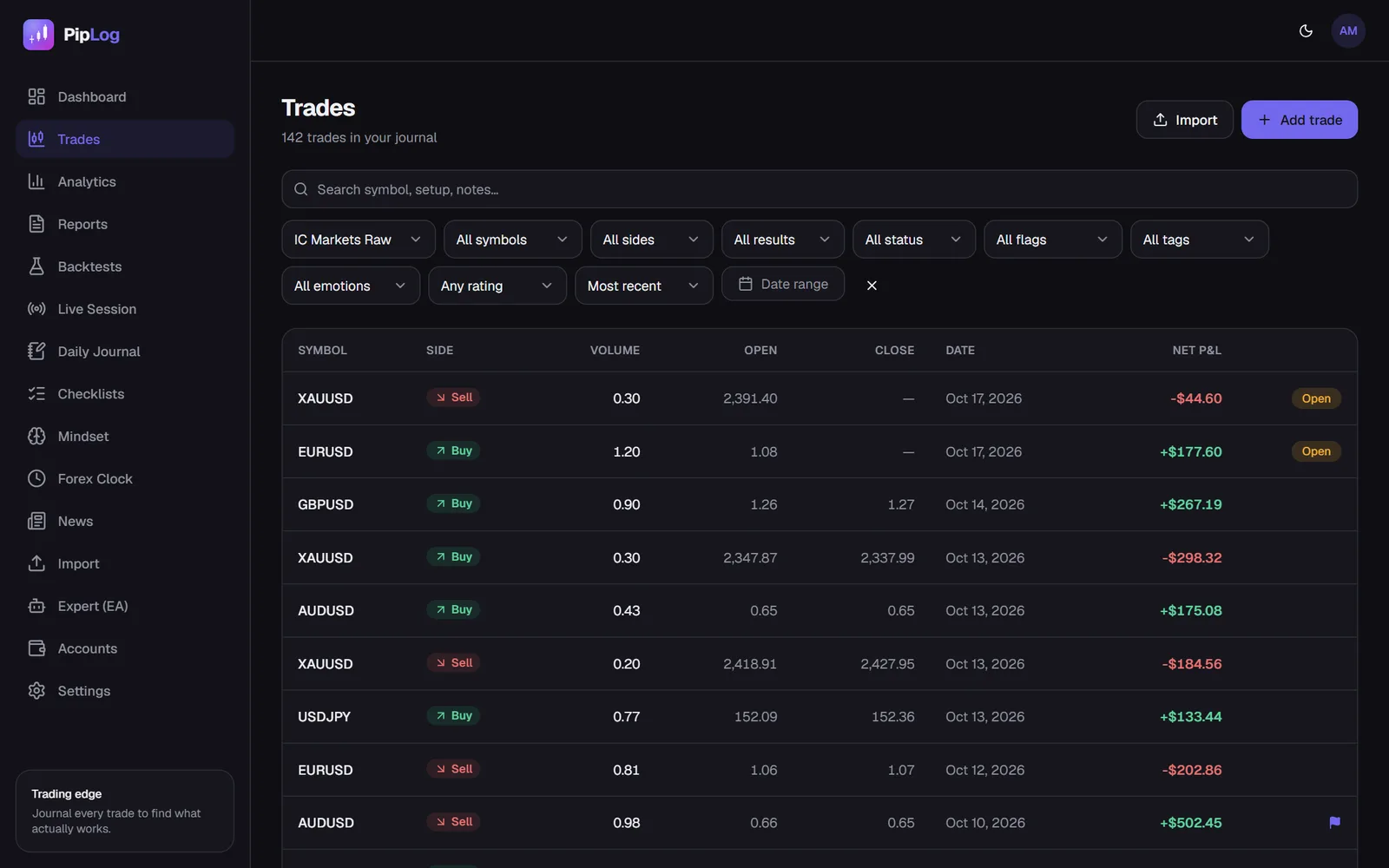
- Import your statement. Export your history from MetaTrader as an HTML report and import it. See our guides for exporting MT5 history and exporting MT4 history.
- Sync live. An expert advisor running on your MT5 terminal can send each trade to your journal as it opens and closes, including chart screenshots. That is what the PipLog EA does.
Either way, re-importing must not create duplicates. PipLog matches every trade by its MetaTrader ticket, so you can import an updated statement every week and only the new trades are added.
Step 3: Journal within the same day
Add your context while the trade is still fresh. Five minutes after the session closes is ideal. Two days later, you will rewrite history to fit the outcome.
A useful rule: write the note before you look at the P&L. Describe what you saw, why you entered and how you managed the position. Then look at the result.
Step 4: Keep a daily log, not just a trade log
Some of your most important data has nothing to do with a single trade. How much did you sleep? Were you anxious going in? Did you follow your plan for the day?
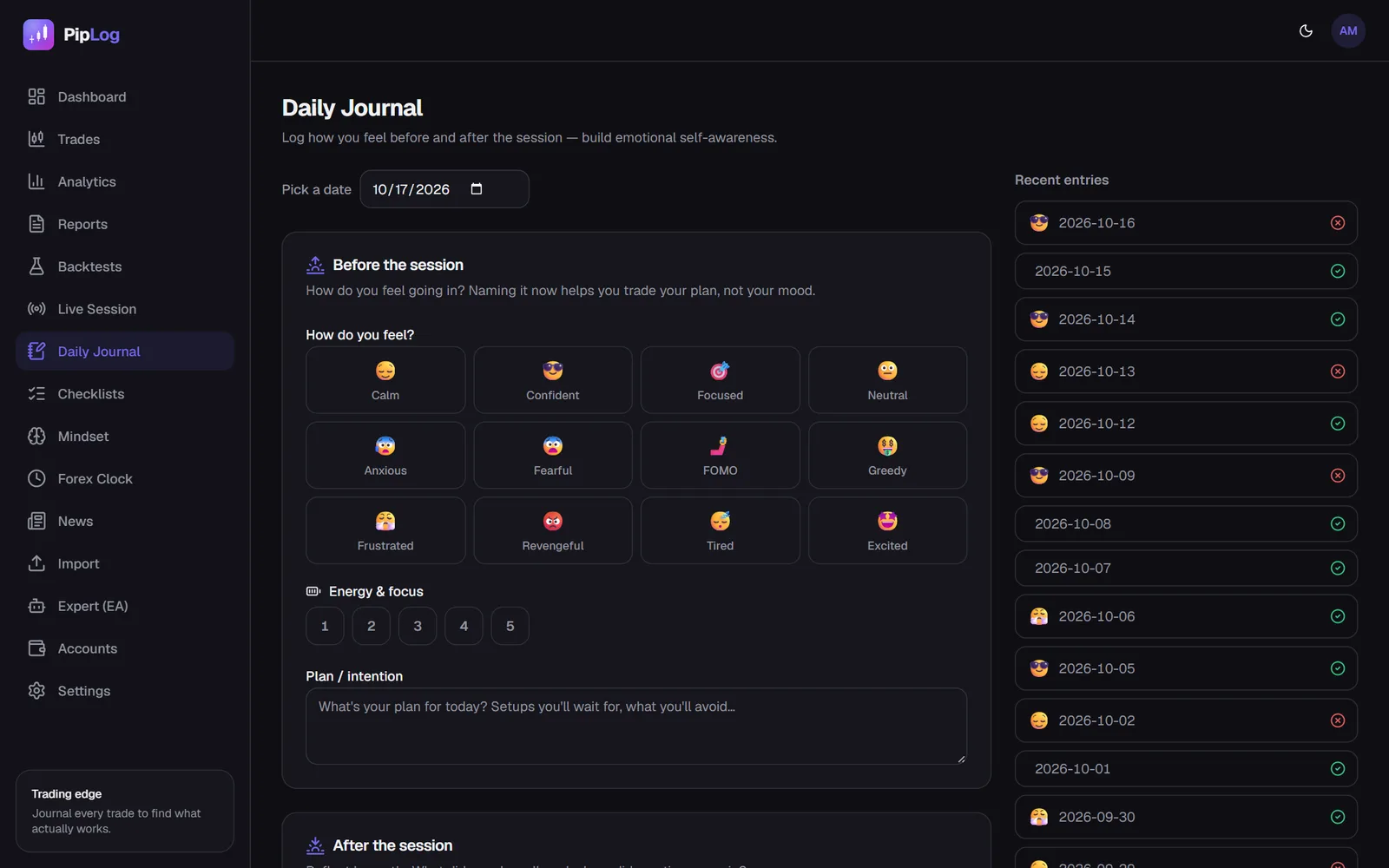
A short pre-session and post-session check-in captures this:
- Before: mood, energy level (1 to 5), and your plan for the day
- After: mood, a short reflection, lessons, mistakes, and a simple yes or no to "did I follow my rules?"
Over a few weeks this shows patterns no trade log can, for example that your worst days all start with low energy or a "need to make it back" mindset. We cover this in depth in journaling for trading psychology.
Step 5: Review weekly, with questions
Data you never review is wasted. Block 30 minutes every weekend and work through the same questions each time:
- What was my net result, win rate and profit factor this week?
- Which setup made the most money? Which lost the most?
- Which trades did I flag as mistakes or rule breaks, and what did they cost?
- Was there a day or time of day where I consistently lost?
- What is the one change I will make next week?
Only pick one change. A journal review that produces ten resolutions produces none.
Step 6: Track the right metrics
You don't need fifty statistics. Start with these and add more as you grow:
| Metric | What it tells you |
|---|---|
| Win rate | How often you win |
| Average win vs. average loss | Whether your winners pay for your losers |
| Profit factor | Gross profit divided by gross loss |
| Expectancy | Average money made per trade |
| Max drawdown | The worst peak-to-trough drop in your equity |
| Average R | Average result measured in units of risk |
We explain each one in 12 trading metrics every trader should track.
Common journaling mistakes
- Only journaling losers. Winners teach you what to repeat. Journal everything.
- Grading by outcome. A well-executed loss is a good trade. A lucky, impulsive win is a bad one.
- Too many fields. If an entry takes more than two minutes, cut fields until it doesn't.
- No initial stop loss. Without it, you can't measure risk, R-multiples or position sizing quality.
- Never reviewing. A journal you don't read is just a backup of your broker statement.
Spreadsheet or journal app?
A spreadsheet is free and flexible, and it is a fine way to start. The downsides show up once you have a few hundred trades: manual entry, formulas that break, and no screenshots. We compare both in trading journal spreadsheet vs. app.
Journal your MT4 & MT5 trades automatically
Import a statement or sync live with the PipLog EA. Win rate, profit factor, expectancy and drawdown are calculated for you.
Start your journalKey takeaways
- Record the broker facts automatically and spend your energy on context: setup, reason, emotion, mistakes.
- Journal the same day, before you look at the result.
- Keep a short daily check-in alongside your trade log.
- Review weekly with fixed questions and commit to one change at a time.